MIS Program

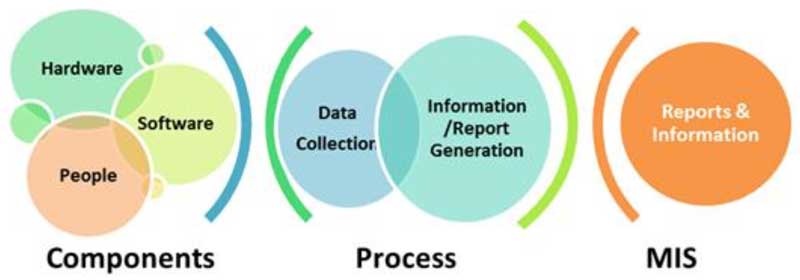
Management Information Systems (MIS) provides information for the managerial activities in an organization. MIS provides accurate and timely information necessary to facilitate the decision making process and enable the organization to make planning, control and operational functions to be carried out effectively.

Management Information systems (MIS) is basically concerned with processing date into information and is then communicated to the various department in an organization for appropriate decision making, includes decision support systems, resource and people management.

Definition of MIS:

  1. The MIS is defined as an integrated system of man and machine for providing the information to support the operations, the management and the decision making function in the organization.
  2. The MIS is defined as a system based on the database of the organization evolved for the purpose of providing information to the people in the organization.What is MIS?
    1. Right information
    2. To the right person
    3. At the right place
    4. At the right time
    5. In the right form
    6. At the right cost

    Characteristic of MIS:

    1. Provide reports with fixed and standard formats – hard copy and soft copy reports.
    2. Uses internal data stored in the computer systems.
    3. End users can develop customs reports.
    4. Requires formal request form users.

Advantages:
The following are some benefits that can be attained for different types of MIS.

  1. SENTANA is able to highlight their strengths and weaknesses due presence of revenue reports, employee’s performance record, etc. The identification of these aspects can help company to improve their business process and operations.
  2. Giving an overall picture of the company and acting as a communication and planning tools.
  3. The availability of customer data and feedback can help SENTANA to align its business processes according to needs of the customers. The effective management of customer data can help SENTANA to perform direct marketing and promotion activities.
  4. Information is considered to be an important asset for any company in the modern competitive world. The customer buying trends and behaviours can be predicted by analisis of sales and revenue reports from operation department.

NEED of MIS
Information needs to be recorded and studied includes relevant department for planning process as well as specific information to know whether one involved in SENTANA CARGO services is performing his/her duty well.

By having a weekly meeting, The executive should see whether anything unusual or unsatisfactory has happened needing immediate remedial measures. A list of date should be presented in the meeting, kept on record for planning purpose and a few performances are designed for monitoring the activities.

Logistics Information systems

Decision Support Systems (DSS)
Help managers to make decisions by providing information, models or analysis tools, for example:

  • Vehicle routing issues.
  • developing order picking systems.
  • optimizing models buyer-seller negotiation.

Executive Information Systems (EIS)
Is a reporting tool that provide quick access to summarized reports coming from all company levels and departments such as accounting, human resources and operations.

Marketing Information Systems (MAIS)
Is designed specifically for managing marketing aspects of the business.

You can DOWNLOAD our MIS program here.

Logistics Principles
The methodology of management of logistics systems is a system of principles, methods, tools, procedures, based on which management decisions are made. The main emphasis in the development of the methodology of management of logistics systems, in our opinion, should be made on the improvement, systematization and development of methods and models for the preparation and decision-making in the performance of logistics activities, as well as the management of the logistics system (supply chain) and its elements (processes).

The management of logistics systems and supply chains is carried out in accordance with a number of principles.

  1. System approach. According to this principle, all elements of the logistics system are considered as interrelated and interacting to achieve a single management goal. A distinctive feature of the system approach is the optimization of the functioning of not the individual elements, but the whole system as a whole.
  2. The principle of general logistics costs. It is aimed at the need to take into account the whole set of management costs of the main and associated flows in the logistics system. The criterion of a minimum of logistical costs is considered one of the basic at optimization of resources in logistical system.
  3. The principle of global optimization. When optimizing the structure in the created logistics system, it is necessary to reconcile the local goals of the functioning of individual links and system elements to achieve a global optimum.
  4. The principle of logistic coordination and integration. Assumes the achievement of a coherent, integral participation of all links and elements of the logistics system in the flow control when implementing the objective function.
  5. The principle of modeling and information-computer support. In accordance with this principle, various models are widely used in the analysis, synthesis and optimization of objects and processes in the logistics system and chains: mathematical, mathematical, graphic, physical, imitative, etc.
  6. The principle of allocating a complex of subsystems, providing the process of logistics management: technical, economic, organizational, legal, personnel, environmental, etc.
  7. The principle of integrated quality management. Is to ensure the reliability of the functioning and high quality of each link of the logistics system to ensure the overall quality of goods and services delivered to consumers.
  8. The principle of humanization of all functions and technological solutions. This means compliance with environmental requirements for environmental protection and ergonomic, social, ethical requirements for personnel work, etc.
  9. The principle of sustainability and adaptability. The logistics system must be resistant to deviations of parameters and environmental factors (for example, to fluctuations in demand, changes in supply conditions, transport tariffs or warehouse operations). With significant fluctuations in the stochastic factors of the external environment, the logistics system must quickly adapt to new conditions, changing the program of operation, parameters and optimization criteria.

However, when considering these principles, it remains unclear, as well as on the basis of what tools can be used to prepare solutions in the field of logistics. Such tools are methods and models of decision-making in logistics.

If you want to know information further or have any question, please contact us!

+62 (21) 2907 5090